maandag 7 januari 2013

Long Ruts on Straights

Nothing reminds me of motocross more than a rutted up, fast, flowing track.  This is the pinnacle obstacle that separates the men from the boys.  If you watched Southwick this past weekend, then you saw the insane ruts in the moist New England sand.  Most beginners find themselves nervous approaching long ruts and often end up on the ground.  It doesn’t matter if a rut is in a corner, on a straight or on the face of a jump, you will encounter one sooner or later.  Some look at this as a burden, but you can actually use these to your advantage.

A lot of people can go fast on a straightaway.  It’s pretty simple; open the throttle as far as possible.  That’s generally how ruts get formed on straights.  People actually use the power of their bikes and it trenches out the soil.  Obviously, the main line will get dug the deepest.  In the beginning of the day, this won’t be a bad choice to use.  It just depends on how it sets you up for the next section.  However, a majority of the time, the main line usually gets too deep and ends up slowing you down.

When the whole straight gets rutted out, things start to get a little tricky.  The middle of the track is going to have deeper ruts than the edges of the track.  So, by taking the edges of the track, you can avoid the choppy mess made by the slower riders and you can save your energy for more important times in the moto.

As with any rut, approaching it with both wheels in line is very important.  You want to keep both wheels in the rut, preventing you from getting cross rutted.  You also maintain your momentum and forward drive, as well.  Once, you have both wheels lined up, keeping your head up and vision ahead is very important.  Staring at the ground right in front of you will only send you one place, the dirt.  That is not where you want to be.  A good guide is to keep your vision a few bike lengths ahead of you.  The faster you go, the further you want to look.

Depending on how deep the ruts are, a good idea is to ride on the balls of your feet (and point your toes in, gripping the cases).  This prevents your feet from getting caught in the rut and ripping your leg off the peg.  As always, you want to be gripping the bike with your knees and applying steady, consistent throttle.  As you get to the end of the straight, there are more than likely going to be braking bumps.  This is where you want to start shifting your weight back slightly to keep you from going over the bars.

Like I said, if you can conquer ruts, you can conquer anything.  It is mind over matter and just keeping good form and looking ahead.  Stay loose and relax; you’ll get through them sooner than you think.

Source: http://www.mxtrainingblog.com/riding-techniques/long-ruts-on-straights/

Georges Jobe Gunnar Johansson

GEICO Endurocross Series ends on a high note in Las Vegas

Source: http://imxmag.blogspot.com/2011/11/geico-endurocross-series-ends-on-high.html

Peter Johansson Rick Johnson

How to Relax before a Motocross Race

Motocross Racing is a dangerous sport and many race drivers feel the stress when the race is drawing near.  Some people said that a trip out, 2 to 3 days before the race will be a good stress reliever. You can hide away in the forest or the mountains or escape the pressure by joining luxury cruises to get pampered and taken cared of before a big race.  According to asport psychology and mental training expert, Dr. Patrick Cohn, motocross and motorcycle race drivers improve performance and lap times by boosting mental preparations, focus and confidence on race day.  There are powerful mental game tools that will boost your mental horsepower, improving one’s confidence, teamwork and consistency.  No matter how skillful and talented a racer is and no matter how updated the equipment and tools he has, he is sure to fail if he is unprepared mentally for the competition.


Dr. Cohn came up with proven mental game strategies to enhance confidence and improve race focus for championship performances.  He developed the RacePsych program that improves mental skills for race driver and the race team’s success.The Mental Power of RacePsych is about developing prepare routines and mental strategies to enter the zone faster, regain composure when stress or frustrations are high or when things go wrong, master the strategies to enhance teamwork and maximize your winning potential, and maintain confidence and momentum to keep you focus throughout the race.


Getting ready for the race is not just about physical preparation or conditioning. Conquering the psychological and emotional barriers is equally important.  When preparing for a race, you need to prepare both physically and psychologically.  Self-doubts and fear are common hurdles for athletes. The difference between the ones who succeed and those who fail can be offset by a psychological plan.

Source: http://www.emotocrossblog.com/how-to-relax-before-a-motocross-race/

Gerard Rond Jean Sebastien Roy

Canadian MX Reigning Champ Colton Facciotti signs with KTM for the next 2 years!

Source: http://imxmag.blogspot.com/2011/10/canadian-mx-reigning-champ-colton.html

Antonio Cairoli Trey Canard

SUZUKI’S HUNTER VALLEY SX DOUBLE

Source: http://imxmag.blogspot.com/2011/11/suzukis-hunter-valley-sx-double.html

Jeff Smith Marty Smith

zondag 6 januari 2013

2011 Holiday Buyers' Guide!

Source: http://imxmag.blogspot.com/2011/12/2011-holiday-buyers-guide.html

Steve Ramon Tyla Rattray

2011 Holiday Buyers' Guide!

Source: http://imxmag.blogspot.com/2011/12/2011-holiday-buyers-guide.html

Carl Nunn Johnny O Mara

Barcia looking to defend Bercy crown; teammate Tomac fired-up for France

Source: http://imxmag.blogspot.com/2011/10/barcia-looking-to-defend-bercy-crown.html

Josh Coppins Cody Copper

Headshake Solutions

When I first started riding big bikes, I was so stoked to finally have all of the power I wanted.  However, with great power, comes great responsibility…courtesy of Uncle Ben from Spiderman.  Sometimes, we can get ahead of ourselves on a rougher track and the braking bumps fight back.  Most of the time, the chop and speed result in head shake.  This uncontrollable shaking can be thwarted with a few adjustments.

One of the most common reasons for head shake is fatigue.  When you are fatigued, your form goes out the window and it gets worse as the moto progresses.  Your elbows drop and you cannot get enough leverage to keep the bars straight.  As you get more and more head shake, you begin to grip harder with your hands and the forearms pump up to bricks.  Sound about right?  When your upper body feels like rubber, the need to grip with your legs becomes even greater.  Again, the quadriceps and hamstrings are a much larger muscle group that can support greater loads of stress for longer periods of times.  Start the moto out with a conscience effort of using your legs more than your arms and you will be better off.

Another problem is RPM range.  The relationship between the motor and suspension is pretty crazy when you really think about it.  When you hear pros run through whoops and moguls, they are running a higher gear.  The RPMs are lower and take some of the load off of the forks and shock.  They travel smoother and won’t bind, which gives you that bouncing effect through the rough stuff.  If you shift down AFTER the braking bumps, you allow your suspension to ride with you, instead of against you.  The forks will travel through the entire stroke and do their job; soak up the terrain.

Weight distribution is also important.  Maintaining your attack position through the rough chop will help keep your elbows up and in good form.  This attack position will place your weight evenly over the bike, allowing you to make changes if need be.  As I have said before, riding on the balls of your feet will give you some extra “suspension” and forces you to grip the bike with your legs.

By throwing good form and the right gear together, head shake will be a thing of the past.  Of course, making sure your sag is set on the shock and your clickers are dialed is important, but the rider can make a big difference.  As always, remember the basics and keep it fun.

Source: http://www.mxtrainingblog.com/riding-techniques/headshake-solutions/

Aigar Leok Tanel Leok

The Scrub

Watching the pros, you can guarantee that every rider is going to scrub.  Even amateurs are perfecting the “Bubba Scrub.”  This is not just something they do for fun.  This is a technique that can help you stay lower in the air and get back on Mother Earth and on the gas.  If you see someone perform the scrub right, it looks effortless and so smooth.  It really is an art form as no 2 scrubs are alike.  For this reason, it is important to start things slow and on a single or something small; eventually working your way up to normal size jumps.

The first thing is to approach the face at a slight angle.  If you plan on leaning to the right, you want to angle yourself to be pointing slightly to the left.  This allows you to turn the bars and lean the bike without scrubbing off of the track.  As the front wheel comes off of the lip, you want to begin to turn the bars the same way you are leaning.  You don’t want to try and make this like a turn.  That will only throw the rear end out and you will still be upright, defeating the whole purpose of this.  Keep this in mind and just lean.  As I said before, this is a unique technique, so it you prefer to stand, stand up.  If you like to sit down, have a seat.

Once you feel you are off of the jump, you want to keep turning the bars down.  This gets the motion of the whip going.  You really want to try and pivot and squeeze with your legs.  This is not just a movement with your arms; you want to help the bike through the flow with your hips and legs.  As you approach the peak of your flight, you will start to feel a point where you need to bring it back.  I have not brought it back in time and I can tell you, it hurts.

You will feel the bike want to come back to its normal, upright position.  To get this process going, simply turn the bars back the other way.  Combine this with a little bit of gas (to get the rear wheel spinning) and the centripetal motion of the wheels will get you back to the right position.  Don’t forget that apply pressure on the foot pegs so you can help bring the bike back with your legs.

When you get the bike straight, be sure to get on the gas.  This will help you drive through any swaps or any problems you have with the scrub when you land.  Like I said, this is a one of kind technique.  You need to practice this and start small.  Jumps that are slower and have long faces will help you out a lot and when you feel comfortable enough, transition to faster, shorter jump faces.  Everything should be a fluid, smooth motion.  It will come faster than you think and you will be throwing scrubs like James himself.

Source: http://www.mxtrainingblog.com/riding-techniques/the-scrub/

Mickael Pichon Jim Pomeroy

WMX Rider Insight: Jackie Ives

In only her second season as a professional Motocross racer, Jackie Ives is currently sitting in 16th position for the WMX point standings through the first four rounds of the 2010 AMA Woman's Motocross Championship Series.


Jackie Ives (17) cheezing on the line at Thunder Valley

You might think 'How cool is it to be racing professional motocross all over the USA!' But it's a lot harder and a lot more work than you might think! Not all racers get the big bucks and the factory rides like James Stewart, Ryan Dungey, and Chad Reed. As a matter of fact, most of the woman racers in the USA have to work quite hard during the week just to make it to the race track!

Source: http://www.supercross.com/mxgirls-feature/wmx-rider-insight-jackie-ives

Andrea Bartolini Willy Bauer

Mastering Starts

Listen to any pro’s interview and they will always say they need to work on start.  The start is one of the single most important aspects of winning.  If you can holeshot, you just saved yourself a lot of tear offs.  Shawn Simpson (European GP MX2 racer) has once said that “Getting the holeshot is 50% of any race.  If you don’t get away with the top three, you have lost 15 seconds or so by the end of the first lap, not to mention getting filled with roost and having to pass a lot of other crazy fast riders.”

So, what is a solid way to get good starts?  First of all, you have to see yourself getting the holeshot.  Like I said in my visualization article, see yourself getting the start from your perspective, then through the eyes of a spectator.  If you can conquer this mental monster, you have beat half of the guys on the line who doubt their abilities.  Now, don’t get cocky; just know you have as good a chance of coming out first as any other rider on the gate.

Most of the gates now are dirt; even the Supercross and National races are all natural.  For me, I always had an easier time with dirt because I could “feel” my rear wheel spinning.  I have had the best results with gates that have the straightest rut outside of the gate.  When you come off the line, you don’t want to follow a sideways rut from a 450 Beginner.  You will lose forward drive and momentum.  So, if you are allowed, try and get a peek before your class lines up.  Be warned however, that the shortest distance to the first turn is not always the fastest line.  You have to take into consideration of getting cut off or pushed out.  That is why you want to look for the straightest line.

Once my gate is picked out, you have two choices for prep.  You can either put some more dirt back into the rut and pack that down or you can clear the loose dirt out of the rut and pack it down.  Both have drawbacks.  If you put dirt in the rut, you run the risk of not packing it hard enough and your rear wheel will just spin.  However, if you choose to clear it out and pack it, your rut will be deeper and you have a greater chance of wheeling out of the gate; this forces you to slip the clutch and loose drive.  Each gate and every soil is different.  Experimenting with different scenarios would be a smart thing to do each time you ride.

Now that you are set up on your gate, start to go over the visualization again.  Get into that “zone”.  For dirt starts, a solid spot on the seat is that “dip”.  Maybe a little bit further up depending on your weight.  You want your weight shifted forward, but not too much because you will spin the rear wheel if you are too far forward.  When that 30 second board goes sideways, it’s time to get those RPMs up.  When looking at the gate, some people say to look at the pin holding the gate up, others look at the actual gate itself.  However, it is up to you.

As for throttle amount, I like a little more than half throttle at the gate.  That way I can still get on the gas harder (if need be) or if I mess up, I can still let off a bit.  A good way to tell if you have the clutch out enough is when your chain tightens up.  This is the point where the clutch is almost un-engaged and all you have to do is GENTLY let it out.  When you let the clutch out, don’t dump it and stab the throttle.  You want everything to be in motion, smooth motion.

For 250f’s, you can get away with 2nd gear.  For the bigger bikes, it is personal preference.  Once you are out of the gate, you want to keep both feet down (start with both feet down on the gate, placing all your weight on the seat) throughout the gear you started in.  If I started in second, I want to keep both feet down until I have to shift up.  When I need to shift up, I bring both feet up.  Shifting with your heel is spotty at best.  Try to get it normally.

It’s a lot to take in, but this is a broken down process.  Try it a few times and it will get easier.

Source: http://www.mxtrainingblog.com/riding-techniques/mastering-starts/

David Philippaerts Mickael Pichon

zaterdag 5 januari 2013

Long Ruts on Straights

Nothing reminds me of motocross more than a rutted up, fast, flowing track.  This is the pinnacle obstacle that separates the men from the boys.  If you watched Southwick this past weekend, then you saw the insane ruts in the moist New England sand.  Most beginners find themselves nervous approaching long ruts and often end up on the ground.  It doesn’t matter if a rut is in a corner, on a straight or on the face of a jump, you will encounter one sooner or later.  Some look at this as a burden, but you can actually use these to your advantage.

A lot of people can go fast on a straightaway.  It’s pretty simple; open the throttle as far as possible.  That’s generally how ruts get formed on straights.  People actually use the power of their bikes and it trenches out the soil.  Obviously, the main line will get dug the deepest.  In the beginning of the day, this won’t be a bad choice to use.  It just depends on how it sets you up for the next section.  However, a majority of the time, the main line usually gets too deep and ends up slowing you down.

When the whole straight gets rutted out, things start to get a little tricky.  The middle of the track is going to have deeper ruts than the edges of the track.  So, by taking the edges of the track, you can avoid the choppy mess made by the slower riders and you can save your energy for more important times in the moto.

As with any rut, approaching it with both wheels in line is very important.  You want to keep both wheels in the rut, preventing you from getting cross rutted.  You also maintain your momentum and forward drive, as well.  Once, you have both wheels lined up, keeping your head up and vision ahead is very important.  Staring at the ground right in front of you will only send you one place, the dirt.  That is not where you want to be.  A good guide is to keep your vision a few bike lengths ahead of you.  The faster you go, the further you want to look.

Depending on how deep the ruts are, a good idea is to ride on the balls of your feet (and point your toes in, gripping the cases).  This prevents your feet from getting caught in the rut and ripping your leg off the peg.  As always, you want to be gripping the bike with your knees and applying steady, consistent throttle.  As you get to the end of the straight, there are more than likely going to be braking bumps.  This is where you want to start shifting your weight back slightly to keep you from going over the bars.

Like I said, if you can conquer ruts, you can conquer anything.  It is mind over matter and just keeping good form and looking ahead.  Stay loose and relax; you’ll get through them sooner than you think.

Source: http://www.mxtrainingblog.com/riding-techniques/long-ruts-on-straights/

Greg Albertyn Jeff Alessi

Crazy Day at the Dojo – Motocross is Safer than Martial Arts

Life-changing

I am just one of those regular motocross riders that occassionally enjoy some downtime. Instead of spending the days relaxing by the beach, I decided to take up martial arts classes because I felt the need to lose weight. I’ve been hearing about the different raves and ramblings of people who lost weight because of martial arts and I thought that it would be a good idea to enroll myself in a mixed martial artsor MMA class to get fit and learn a thing or two about kicking butt.

It’s a whole new world

When I enrolled in an MMA class a couple of months ago, I wasn’t sure what I was getting myself into. The first session felt like getting on my bike for the first time and doing my first jump. The rules and etiquette of the dojo were simple, and yet it felt so complicated for me. I wasn’t exactly used to the idea of me bowing all the time to my seniors and sensei, but I did anyways. Somehow, I felt compelled to do and follow everything that was written on the dojo rulebook.

The first few days

I was serious in taking the classes, even if it meant having to sacrifice two to three hours of my time every day. My first week in the dojo was both good and bad. I didn’t realize that I could feel pain in every part of my body without having to break every bone. My first sparring session gave me two bruises in the forearm, one bruise in the ribs, and one busted lip. This was the equivalent of a minor slip and slide in motocross, and I’ve had me a few of those on every ride that I had.  Thankfully, I shelved my pride as instructed by the dojo rules and etiquette, otherwise it would’ve been a crushing blow to the ego.

Then and now

Two months into the classes and I can firmly say and conclude that motocross is a lot safer than martial arts. I enjoy these two sports and I want to incorporate martial arts into my lifestyle. It helps to fill the void when I’m not practicing for any Motocross challenges or events, and it keeps me in shape. Of course, I am still open and willing to accept any injury that I get from the future sparring sessions and/or drills from my MMA classes.

Source: http://www.emotocrossblog.com/crazy-day-at-the-dojo-motocross-is-safer-than-martial-arts/

Håkan Carlquist Ricky Carmichael

MARITIME MOTORSPORTS HALL OF FAME 2011 INDUCTEES INCLUDE NATIONAL LEGENDS

Source: http://imxmag.blogspot.com/2011/10/maritime-motorsports-hall-of-fame-2011.html

Gilbert De Roover Clement Desalle

Canadian MX Reigning Champ Colton Facciotti signs with KTM for the next 2 years!

Source: http://imxmag.blogspot.com/2011/10/canadian-mx-reigning-champ-colton.html

Connor McGechan Jeremy McGrath

CMX @ MotoPark

Source: http://imxmag.blogspot.com/2011/10/cmx-motopark.html

Darryll King Shayne King

Brian Deegan Unveils the Metal Mulisha Monster Truck

Source: http://imxmag.blogspot.com/2011/11/brian-deegan-unveils-metal-mulisha.html

Torlief Hansen Marcus Hansson

In remembrance – eleven years

Source: http://feedproxy.google.com/~r/BikerChickNews/~3/KCEjqaVNzHM/

Steve Stackable Jeff Stanton

vrijdag 4 januari 2013

Effective Braking for Faster Cornering

Everyone can go fast by hold the throttle pinned on the straights, but it’s when it comes time to slow down that separates the pros from the amateurs.  Next time you are at your local track, watch the fast guys around the track; they are either on the gas or braking.  Slower riders tend to have a bad habit of letting off before the corner and then braking.  However, teaching yourself to hold it on longer isn’t enough.  Learning how and when to use both brakes effectively will help take your corner speed to the next level.

Telling yourself to hold the gas on a split second longer is easier said than done, but it can be a life saver on the start.  Unlike road racing, there are no markers to tell us how close the corner is.  However, we can use simple objects like rocks, fencing or foliage.  Finding a marker can help you visualize your spot on the track and help you hold the throttle down longer.

Many people have their own theory on how to brake properly.  Some prefer just the front while others like the back.  I believe that there is no definite answer.  Each brake has different purposes.  The front brake is great for diving into inside ruts and coming to a stop quickly, while the rear keeps the rear wheel planted to the ground and keeps your momentum up.  Another interesting thing that seems to help me is to “push” the bike in the ground.  Trying to weight front or rear down will put more force on the ground to get that extra friction for added stopping power.

One thing that aids in your momentum and drive is to avoid locking the brakes.  When you lock up the rear brake, there is no control over the traction and where the wheel goes.  All of your RPMs drop and it just creates braking bumps even faster.  Your best bet is to “chatter” the rear.  This is a method where the rear wheel is spinning, but at a much slower rate.  This is great for maintaining drive in deep soil and it squats the rear end down to avoid swapping out.

Each situation is different, but remembering how your brakes control deceleration, you can utilize each one to its maximum potential.  If you have an outside line in a corner that looks good, use more rear brake than front.  For insides, you would be better off grabbing the front and getting that front end down.  Becoming comfortable with both brakes can allow you to have faster entry speed in any corner.


Source: http://www.mxtrainingblog.com/riding-techniques/effective-braking-for-faster-cornering/

Rui Goncalves Josh Grant

Graham Jarvis has taken victory at the Wildwood Rock Extreme Enduro

Source: http://imxmag.blogspot.com/2011/11/graham-jarvis-has-taken-victory-at.html

David Philippaerts Mickael Pichon

Wojo at WEC #7 at Burnt River

Source: http://imxmag.blogspot.com/2011/10/wojo-at-wec-7-at-burnt-river.html

Christophe Pourcel Sebastien Pourcel

Headshake Solutions

When I first started riding big bikes, I was so stoked to finally have all of the power I wanted.  However, with great power, comes great responsibility…courtesy of Uncle Ben from Spiderman.  Sometimes, we can get ahead of ourselves on a rougher track and the braking bumps fight back.  Most of the time, the chop and speed result in head shake.  This uncontrollable shaking can be thwarted with a few adjustments.

One of the most common reasons for head shake is fatigue.  When you are fatigued, your form goes out the window and it gets worse as the moto progresses.  Your elbows drop and you cannot get enough leverage to keep the bars straight.  As you get more and more head shake, you begin to grip harder with your hands and the forearms pump up to bricks.  Sound about right?  When your upper body feels like rubber, the need to grip with your legs becomes even greater.  Again, the quadriceps and hamstrings are a much larger muscle group that can support greater loads of stress for longer periods of times.  Start the moto out with a conscience effort of using your legs more than your arms and you will be better off.

Another problem is RPM range.  The relationship between the motor and suspension is pretty crazy when you really think about it.  When you hear pros run through whoops and moguls, they are running a higher gear.  The RPMs are lower and take some of the load off of the forks and shock.  They travel smoother and won’t bind, which gives you that bouncing effect through the rough stuff.  If you shift down AFTER the braking bumps, you allow your suspension to ride with you, instead of against you.  The forks will travel through the entire stroke and do their job; soak up the terrain.

Weight distribution is also important.  Maintaining your attack position through the rough chop will help keep your elbows up and in good form.  This attack position will place your weight evenly over the bike, allowing you to make changes if need be.  As I have said before, riding on the balls of your feet will give you some extra “suspension” and forces you to grip the bike with your legs.

By throwing good form and the right gear together, head shake will be a thing of the past.  Of course, making sure your sag is set on the shock and your clickers are dialed is important, but the rider can make a big difference.  As always, remember the basics and keep it fun.

Source: http://www.mxtrainingblog.com/riding-techniques/headshake-solutions/

Mike Bell John van den Berk

Mastering Starts

Listen to any pro’s interview and they will always say they need to work on start.  The start is one of the single most important aspects of winning.  If you can holeshot, you just saved yourself a lot of tear offs.  Shawn Simpson (European GP MX2 racer) has once said that “Getting the holeshot is 50% of any race.  If you don’t get away with the top three, you have lost 15 seconds or so by the end of the first lap, not to mention getting filled with roost and having to pass a lot of other crazy fast riders.”

So, what is a solid way to get good starts?  First of all, you have to see yourself getting the holeshot.  Like I said in my visualization article, see yourself getting the start from your perspective, then through the eyes of a spectator.  If you can conquer this mental monster, you have beat half of the guys on the line who doubt their abilities.  Now, don’t get cocky; just know you have as good a chance of coming out first as any other rider on the gate.

Most of the gates now are dirt; even the Supercross and National races are all natural.  For me, I always had an easier time with dirt because I could “feel” my rear wheel spinning.  I have had the best results with gates that have the straightest rut outside of the gate.  When you come off the line, you don’t want to follow a sideways rut from a 450 Beginner.  You will lose forward drive and momentum.  So, if you are allowed, try and get a peek before your class lines up.  Be warned however, that the shortest distance to the first turn is not always the fastest line.  You have to take into consideration of getting cut off or pushed out.  That is why you want to look for the straightest line.

Once my gate is picked out, you have two choices for prep.  You can either put some more dirt back into the rut and pack that down or you can clear the loose dirt out of the rut and pack it down.  Both have drawbacks.  If you put dirt in the rut, you run the risk of not packing it hard enough and your rear wheel will just spin.  However, if you choose to clear it out and pack it, your rut will be deeper and you have a greater chance of wheeling out of the gate; this forces you to slip the clutch and loose drive.  Each gate and every soil is different.  Experimenting with different scenarios would be a smart thing to do each time you ride.

Now that you are set up on your gate, start to go over the visualization again.  Get into that “zone”.  For dirt starts, a solid spot on the seat is that “dip”.  Maybe a little bit further up depending on your weight.  You want your weight shifted forward, but not too much because you will spin the rear wheel if you are too far forward.  When that 30 second board goes sideways, it’s time to get those RPMs up.  When looking at the gate, some people say to look at the pin holding the gate up, others look at the actual gate itself.  However, it is up to you.

As for throttle amount, I like a little more than half throttle at the gate.  That way I can still get on the gas harder (if need be) or if I mess up, I can still let off a bit.  A good way to tell if you have the clutch out enough is when your chain tightens up.  This is the point where the clutch is almost un-engaged and all you have to do is GENTLY let it out.  When you let the clutch out, don’t dump it and stab the throttle.  You want everything to be in motion, smooth motion.

For 250f’s, you can get away with 2nd gear.  For the bigger bikes, it is personal preference.  Once you are out of the gate, you want to keep both feet down (start with both feet down on the gate, placing all your weight on the seat) throughout the gear you started in.  If I started in second, I want to keep both feet down until I have to shift up.  When I need to shift up, I bring both feet up.  Shifting with your heel is spotty at best.  Try to get it normally.

It’s a lot to take in, but this is a broken down process.  Try it a few times and it will get easier.

Source: http://www.mxtrainingblog.com/riding-techniques/mastering-starts/

Jim Pomeroy Christophe Pourcel

CGRT Race Report

Source: http://imxmag.blogspot.com/2011/10/cgrt-race-report.html

Sten Lundin Jeremy Lusk

Sandstorm postponed to October 23

Source: http://imxmag.blogspot.com/2011/10/sandstorm-postponed-to-october-23.html

Peter Johansson Rick Johnson

Go Pro Moto – QLD Moto Park MX1 Motocross

Some footage from my Go Pro Moto helmet cam. Riding a CRF450 on motocross track 1 at Queensland Moto Park. The track is rutted and has the normal braking and acceleration bumps as it doesn’t seem to be prepped that often. Like track two it has a handful of table tops but with a mix of tight and wide corners and short straights.

Overall the track is not bad considering what off road riding parks are available in Queensland.


Source: http://www.superfreestylemotocross.com/blog/go-pro-moto-qld-moto-park-mx1-motocross/

Roger De Coster Ken De Dycker

donderdag 3 januari 2013

CMX @ MotoPark

Source: http://imxmag.blogspot.com/2011/10/cmx-motopark.html

Rob Herring George Holland

Setting up for Corners Mid-Flight

Saving time on the track is always a priority.  If you can master a technique to get faster, you better take advantage of it.  When things get tight during racing, it’s the little things that add up and make a big difference in the end, especially if you can set up for corner more efficiently.  When the outside is not available or you need to make a pass on the inside, sometimes setting up mid air for a corner can help get that pass made.

If there is a berm already there, you don’t have to do this, but if the inside is flat off the downside, this technique will come in handy.  You want to make sure that you have the jump sized up before trying to sit down and set up mid air.  If you come up short or over shoot it, this will hurt.  Especially guys.  Once you have everything timed right, you want to loosen up in the air, trying to get the back end of the bike out just slightly.  You can let the outside leg out and lean in to get the rear end moving.

As you approach the down side, you want to start moving into the correct position for the corner.  You don’t necessarily have to be seated in the air, but as long as you are ready for the landing and corner, this transition will be smooth.  When you land, make sure that your inside leg is ready for the forces of gravity; keep it high and stiff.

If traction is not a problem, you can apply a handful of throttle and accelerate towards the corner.  Remember to keep weight on the outside foot peg and outside elbow up as this will plant you into ground for more traction.   If the downside is harder, you will have to apply the throttle with grace as you don’t want to the rear end to break loose.

This is something that you should start small on and on a jump you are comfortable with.  No sense in trying this on a new jump and getting hurt.


Source: http://www.mxtrainingblog.com/riding-techniques/setting-up-for-corners-mid-flight/

Guennady Moisseev Bobby Moore

Brian Deegan Unveils the Metal Mulisha Monster Truck

Source: http://imxmag.blogspot.com/2011/11/brian-deegan-unveils-metal-mulisha.html

Jeff Smith Marty Smith

Setting up for Corners Mid-Flight

Saving time on the track is always a priority.  If you can master a technique to get faster, you better take advantage of it.  When things get tight during racing, it’s the little things that add up and make a big difference in the end, especially if you can set up for corner more efficiently.  When the outside is not available or you need to make a pass on the inside, sometimes setting up mid air for a corner can help get that pass made.

If there is a berm already there, you don’t have to do this, but if the inside is flat off the downside, this technique will come in handy.  You want to make sure that you have the jump sized up before trying to sit down and set up mid air.  If you come up short or over shoot it, this will hurt.  Especially guys.  Once you have everything timed right, you want to loosen up in the air, trying to get the back end of the bike out just slightly.  You can let the outside leg out and lean in to get the rear end moving.

As you approach the down side, you want to start moving into the correct position for the corner.  You don’t necessarily have to be seated in the air, but as long as you are ready for the landing and corner, this transition will be smooth.  When you land, make sure that your inside leg is ready for the forces of gravity; keep it high and stiff.

If traction is not a problem, you can apply a handful of throttle and accelerate towards the corner.  Remember to keep weight on the outside foot peg and outside elbow up as this will plant you into ground for more traction.   If the downside is harder, you will have to apply the throttle with grace as you don’t want to the rear end to break loose.

This is something that you should start small on and on a jump you are comfortable with.  No sense in trying this on a new jump and getting hurt.


Source: http://www.mxtrainingblog.com/riding-techniques/setting-up-for-corners-mid-flight/

Joël Smets Jeff Smith

Freedom Rock Ride 2012

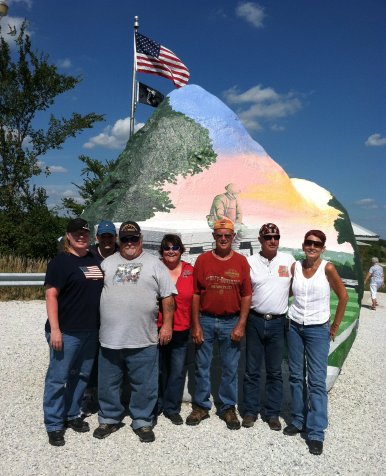
I recently had a few days off from work and the days were sunny so I was determined to get at least a couple of good day-rides in. Steve had been wanting to get out to see the 2012 mural on the Freedom Rock, so Greenfield was our first destination along with Shirley, Garry, Dave R., Kristin and Teri Ann.

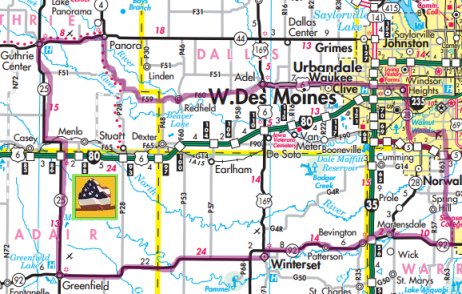
It was going to be another very hot day, so even though Greenfield and the Rock are only about 60 miles away, we planned a stop halfway. We took off along SW 9th Street in Des Moines, which quickly becomes County Road R63 heading south, and turned west at Highway 92. In the past we’ve stopped frequently at the Casey’s General Store that sits a hundred feet from the junction of 92 and 169 at Winterset, and such was my plan here again – but, upon making the left turn off 92 I quickly realized that the familiar building was gone and the site was under re-construction. Thank goodness this is Iowa, and there is always another Casey’s!

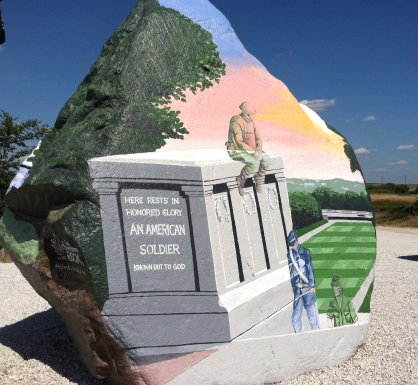
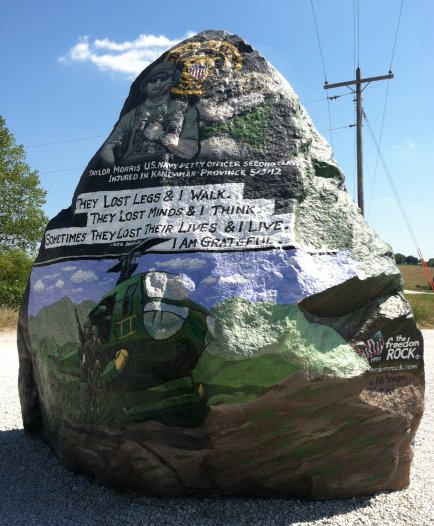
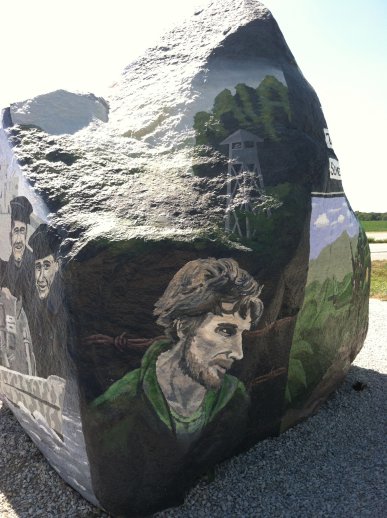
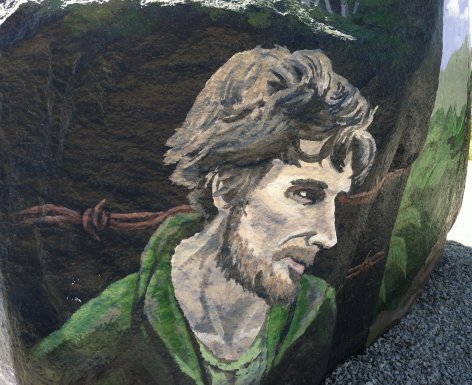
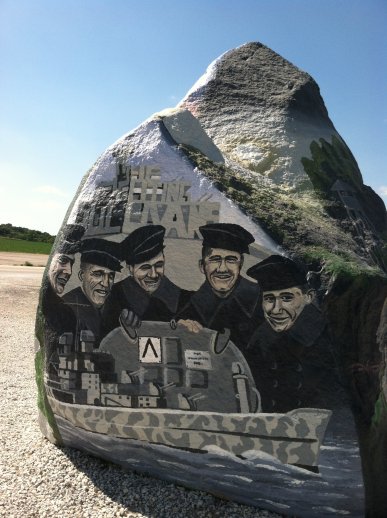
After a brief stop to “stretch and hydrate” (as my former boss used to say), we took off again to the west – traveled the 24 miles to Greenfield along 92, then north another 12 miles along Highway 25 to the Freedom Rock – so named because local artist Ray Sorensen paints a new military-themed mural on the rock every year. This year’s Rock recognizes the Tomb of the Unknowns, US Naval Petty Officer Taylor Morris, the POW experience, and Iowa’s Sullivan Brothers.


The Rock has become a destination for bikers, veterans, and other military supporters from around the country. There is a contingent of bikers that now stops here each year while en route from the west coast to the Viet Nam memorial in Washington, D.C. just before Memorial Day.

While at the Rock we encountered an older gentleman who was also visiting – turns out he is a Greenfield area resident and also a WWII veteran and Pearl Harbor survivor. He said he visits the rock frequently to chat with the people who come to see it.

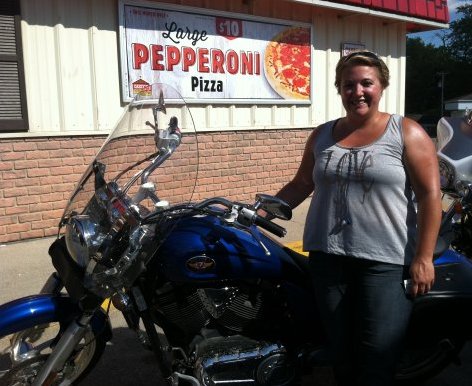
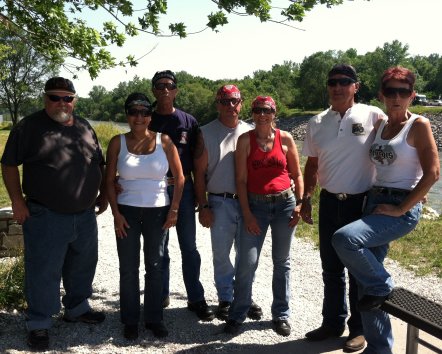
We also met a fellow rider – a gal named Michele who had come down on a solo ride from her home in Story City. She gave us a terrific gift – a group photo that included ALL of us (rather than the usual “all minus the photographer”). It was neat to chat with her there at the Rock, and we invited her to head north with us to our next stop at Guthrie Center.

We left the Rock and headed north along Highway 25, which took us into Guthrie Center and yes, another Casey’s. This was the same location where we’d stopped in 2006 and met the woman whose dad helped trowel Albert the Bull over in Audubon.

Visited a little more with Michele here, and finalized our route home. She traveled a few miles east with us to Panora, where we waved a farewell and turned to the south on County Road P28. We picked up F59 a few miles outside of Panora, then F60 outside of Redfield, and stopped again for a final stretch-and-hydrate at Adel. We picked up Highway 6 going east out of Adel, and took that all the way into Des Moines. It’s funny that this used to be a very rural drive. Now, after decades of record growth westward from Des Moines, it’s a short 7 mile path from Adel to Waukee and then 100 percent developed from Waukee clear through to the far east side of the Des Moines area. So we’re now “back in town” even though we are riding through a town that used to be considered “out in the boondocks.”

In all we traveled 150 miles and were pretty well roasted by the time we got home (I was going to say we were “baked,” but I think that might mean something else!), but it was certainly a great way to spend a vacation day!

Source: http://feedproxy.google.com/~r/BikerChickNews/~3/VABm68vrWiY/

Damon Bradshaw Goat Breker

No more seniors at stanmore motocross track

Gold coast city council has made the decision to prevent seniors from riding at Stanmore motocross track indefinitely. The decision handed down by Senior Recreation Officer Bruce Flick bflick@goldcoast.qld.gov.au means the end of the road for a club which has operated for over 30 years catering for senior and junior motocross.

The decision also stipulates that the club could be reopened for Junior riders supporting up to 250cc bikes. One might ask why not seniors up to 250cc as a compromise if noise is the only issue. However further constraints on any future operation of the club facilities are biased towards gold coast residents over both committee and general club members who live in other outer Brisbane and Sunshine Coast districts.

The Gold Coast council is also supportive of the Gold Coast motorcycle club at Reedy Creek facility looking into town planning approval for the future use catering of the location for all bike classes.


Bruce Flick

Source: http://www.superfreestylemotocross.com/blog/no-more-seniors-at-stanmore-motocross-track/

Victor Leloup Aigar Leok

Chrome Divas come to Des Moines

I’ve been keeping this under my helmet for awhile, but am so excited to finally be able to mention that the CHROME DIVAS have come to Des Moines – and that I am a founding member!

While poking around on the Web one night last summer I did some reading about this organization for women motorcycle enthusiasts, founded in 2002. I was surprised to learn that although there was a very large and active chapter in the Cedar Rapids area, there was not yet a chapter here in Des Moines.

So, together with my gal pals Shirley, Susan (Coyote) and Stephanie (Iowa Harley Girl), we launched the Chrome Divas of Des Moines in August 2011. We’ve added two additional members since then – Janet (“Seven Over”) and Penney (“One Cent”).

The Chrome Divas is simply an organization for women who share a passion for motorcycles – all brands, all levels of riding. We currently meet monthly, and we’ll be creating opportunities to ride together and work on behalf of some our favorite community organizations. Our primary mission is four-fold:

  • Promote a positive image of women who ride, and of motorcycling in general.
  • Provide a social atmosphere for women who ride or simply love motorcycles to gather and get to know each other.
  • Give back to our community by participating in local non-profit events and activities.
  • Ride and have fun!

We’re lucky and thankful to have Sambetti’s, a local bar and grill, as the “official home of the Chrome Divas of Des Moines.” A big THANK YOU to Paul Strome, owner of Sambetti’s, for his encouragement and support of our little group!  (I personally recommend the “10 oz top” special, the chicken strips, the house dressing on the crisp, cold salads, and – OMG – the ONION RINGS!! Lunch, dinner or drinks – Sambetti’s is one of my favorite spots in Des Moines!)

As for membership, right now we’re keeping growth slow and purposeful so as not to get too big too fast, but we are excited about being part of this great organization and are definitely planning to increase our numbers!


Source: http://feedproxy.google.com/~r/BikerChickNews/~3/vKuS2ihxylg/

Mike Kiedrowski Darryll King

woensdag 2 januari 2013

In remembrance – eleven years

Source: http://feedproxy.google.com/~r/BikerChickNews/~3/KCEjqaVNzHM/

Yves Demaria Gilbert De Roover

CGRT Race Report

Source: http://imxmag.blogspot.com/2011/10/cgrt-race-report.html

Carl Nunn Johnny O Mara

Headshake Solutions

When I first started riding big bikes, I was so stoked to finally have all of the power I wanted.  However, with great power, comes great responsibility…courtesy of Uncle Ben from Spiderman.  Sometimes, we can get ahead of ourselves on a rougher track and the braking bumps fight back.  Most of the time, the chop and speed result in head shake.  This uncontrollable shaking can be thwarted with a few adjustments.

One of the most common reasons for head shake is fatigue.  When you are fatigued, your form goes out the window and it gets worse as the moto progresses.  Your elbows drop and you cannot get enough leverage to keep the bars straight.  As you get more and more head shake, you begin to grip harder with your hands and the forearms pump up to bricks.  Sound about right?  When your upper body feels like rubber, the need to grip with your legs becomes even greater.  Again, the quadriceps and hamstrings are a much larger muscle group that can support greater loads of stress for longer periods of times.  Start the moto out with a conscience effort of using your legs more than your arms and you will be better off.

Another problem is RPM range.  The relationship between the motor and suspension is pretty crazy when you really think about it.  When you hear pros run through whoops and moguls, they are running a higher gear.  The RPMs are lower and take some of the load off of the forks and shock.  They travel smoother and won’t bind, which gives you that bouncing effect through the rough stuff.  If you shift down AFTER the braking bumps, you allow your suspension to ride with you, instead of against you.  The forks will travel through the entire stroke and do their job; soak up the terrain.

Weight distribution is also important.  Maintaining your attack position through the rough chop will help keep your elbows up and in good form.  This attack position will place your weight evenly over the bike, allowing you to make changes if need be.  As I have said before, riding on the balls of your feet will give you some extra “suspension” and forces you to grip the bike with your legs.

By throwing good form and the right gear together, head shake will be a thing of the past.  Of course, making sure your sag is set on the shock and your clickers are dialed is important, but the rider can make a big difference.  As always, remember the basics and keep it fun.

Source: http://www.mxtrainingblog.com/riding-techniques/headshake-solutions/

Torsten Hallman Bob Hannah

2012 AMA Supercross Schedule


The 2012 supercross series has been won by Ryan Villipoto with 3 rounds remaining in the series. The 2012 AMA Supercross Schedule is listed below.

January 7 Angel Stadium – Anaheim
January 14 Chase Field – Phoenix
January 21 Dodger Stadium – Los Angeles
January 28 Overstock.com Stadium – Oakland
February 4 Angel Stadium – Anaheim
February 11 Qualcomm Stadium – San Diego
February 18 Cowboys Stadium – Dallas
February 25 Georgia Dome – Atlanta
March 3 Edward Jones Dome – St. Louis
March 10 Daytona Int’l Speedway – Daytona
March 17 Lucas Oil Stadium – Indianapolis
March 24 Rogers Centre – Toronto
March 31 Reliant Stadium – Houston
April 14 Mercedes Benz Super Dome – New Orleans
April 21 CenturyLink Field – Seattle
April 28 Rice-Eccles Stadium – Salt Lake City
May 5 Sam Boyd Stadium – Las Vegas

Source: http://www.superfreestylemotocross.com/blog/2012-ama-supercross-schedule/

Rui Goncalves Josh Grant

Zip-Ty Husqvarna Wraps Up WORCS Season

Source: http://imxmag.blogspot.com/2011/11/zip-ty-husqvarna-wraps-up-worcs-season.html

Jeremy Lusk Billy MacKenzie

CMX @ MotoPark

Source: http://imxmag.blogspot.com/2011/10/cmx-motopark.html

Alex Salvini Donny Schmit

Holy crap, it’s been HOT!

Well June was pretty much a bust for riding – the weather has really been an issue. As I finish up this post it’s July 8 and the record-setting heatwave finally broke last night. For the past few weeks we’ve had unseasonably high temperatures in the mid- to upper 90′s and humidity pushing it over 100 nearly every day. This is quite unusual for June – usually that’s the month where the riding season hits its stride here in Iowa. This year, it was mostly a month to stay indoors and try to keep cool.

We did have one really nice Saturday on the bikes mid-month (obviously I am a little behind in posting about it!).

I had wanted to take a day-ride that day, but we didn’t plan far enough in advance so we decided to hit the Big Barn Open House instead. We met up with Garry and Shirley, and turns out they had come up with Garry’s son Mike and his girlfriend Tina, and their friends Charlie and Rita.

We poked around Big Barn for awhile and enjoyed the free lunch, then decided to take an extended “up around the lake” ride including the Madrid loop.

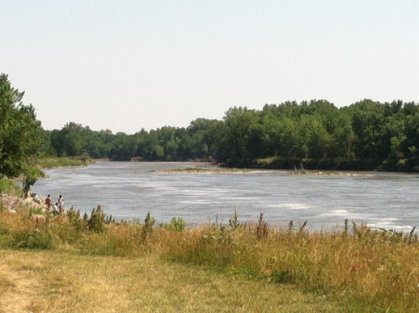
This is an easy ride with a very nice route. It takes us up the backside of Saylorville Lake with its lovely homes, across the Mile Bridge (boy the lake is LOW this year!), and up to the small town of Madrid, where we made a potty-and-beverage stop. Everyone noted the killer shrub that we had encountered in the middle of the road a few miles back (what IS IT with stuff in the road this year??) – fortunately we all got around it without being attacked.

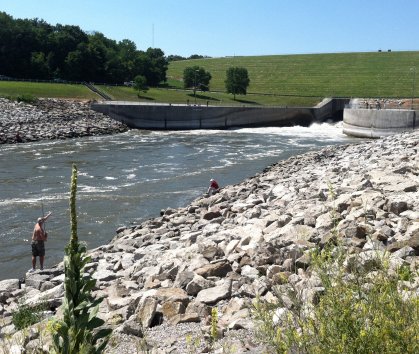
We left Madrid going east on Highway 210, then south through the tiny town of Sheldahl and back into Polk City north of Saylorville. Stopped at the Saylorville spillway where the dammed-up lake is control-fed out into the Des Moines river. From there we took a round-about route through Johnston and down into Des Moines where we stopped at Sambetti’s for a beverage before heading home.

Although it wasn’t the epic day-ride I’d been hoping to take, it turned out to be a great afternoon anyway because of the new riding friends and of course the Iowa scenery. The next couple of weekends would turn out to be occupied with an out-of-state funeral and then the Good Guys Heartland Nationals hot rod show, all in the middle of a record-setting heat-wave.

The heat, fortunately, has broken at least for the moment – but it has felt more like August than June, so my internal “calendar” is a little off. We took a neat ride today that I’ll post about soon!

Source: http://feedproxy.google.com/~r/BikerChickNews/~3/n3JzQC4dbVY/

Ake Jonsson Julien Bill

dinsdag 1 januari 2013

Black Duck Valley motocross park to reopen again!

The operators of Black Duck Valley Motocross park have resolved issues that prevented access to the park and have commenced cleaning up in an effort to reopen the facility. The latest update on the website suggests that it will reopen some time in the coming weeks. I really thought the dirt bike park was closed for good this time but its soon to be back up and running yet again!

Update – 25th APRIL 2012

Access issues to the park have now been resolved. Cleanup has now commenced and we will be back in operation as soon as possible. Please contact the park on 07 54629116 for further details. Regular updates will be made to the website over the coming weeks.

Can I insure my Dirt Bike?

Source: http://www.superfreestylemotocross.com/blog/black-duck-valley-motocross-park-to-reopen-again/

Brian Myerscough Maximilian Nagl

KTM Canada adds National #2 Dusty Klatt to powerful MX1 Team

Source: http://imxmag.blogspot.com/2011/12/ktm-canada-adds-national-2-dusty-klatt.html

Donnie Hansen Torlief Hansen

Wishing you a very happy new year !

Source: http://feedproxy.google.com/~r/BikerChickNews/~3/UIGuA4NrUbs/

Joël Robert Ken Roczen

Video Hi-lites: German MX GP 2012

Here is the video recap of the final round of the 2012 FIM World Motocross Championships, courtesy of Monster Energy.

The big winners yesterday? Tony Cairoli from Italy in the MX 1 class, and Tommy Searle from the UK in MX 2. Kenny Roczen put on a nice show for the home fans as he made his first ever start in MX1.

You can view the results and point standings of the race here on Supercross.com.

Source: http://www.supercross.com/features/video-hi-lites-german-mx-gp-2012

Bengt Åberg Greg Albertyn

FMX Team


FMX Team 3 is not here yet but FMX Team 2 is an online game which will give you hours of fun in the comfort or your own living room. A great way to get through the times when you can’t get out there and hit some ramps for real!

Play it now for free when once it loads below…

2nd edition of FMX Team. With downhill, big jump, new tricks, custom bike tuning and much more!

Source: http://www.superfreestylemotocross.com/blog/fmx-team-3/

Xavier Boog Damon Bradshaw

Stewart injury out of 2012 AMA supercross for now


James Stewart’s crash at Indianapolis will prevent him from racing this weekend at Toronto. James has been


under observation over the last few days and has stated that the crash “aggravated a couple old injuries and I’ll need time to fully recover from that”

James will continue to work hard on recovery and will re-evaluate is injuries and race readiness before Houston. But for now he is not ready to compete at the level required. “’I wouldn’t be able push myself at the pace needed to run with the guys out there”

Source: http://www.superfreestylemotocross.com/blog/stewart-injury-out-of-2012-ama-supercross-for-now/

James Stewart Jr Brian Stonebridge

Ontario Arenacross Championship & Practice Facility Re-Opens in Wallaceburg for 2011 /2012 Season

Source: http://imxmag.blogspot.com/2011/11/ontario-arenacross-championship.html

Brett Metcalfe Heikki Mikkola